
• Login
    View Item 
    •   DSpace Home
    • Students & Alumnae
    • Undergraduate Thesis
    • Faculty of Sociocultural Sciences
    • English Language Education
    • View Item
    •   DSpace Home
    • Students & Alumnae
    • Undergraduate Thesis
    • Faculty of Sociocultural Sciences
    • English Language Education
    • View Item
    JavaScript is disabled for your browser. Some features of this site may not work without it.

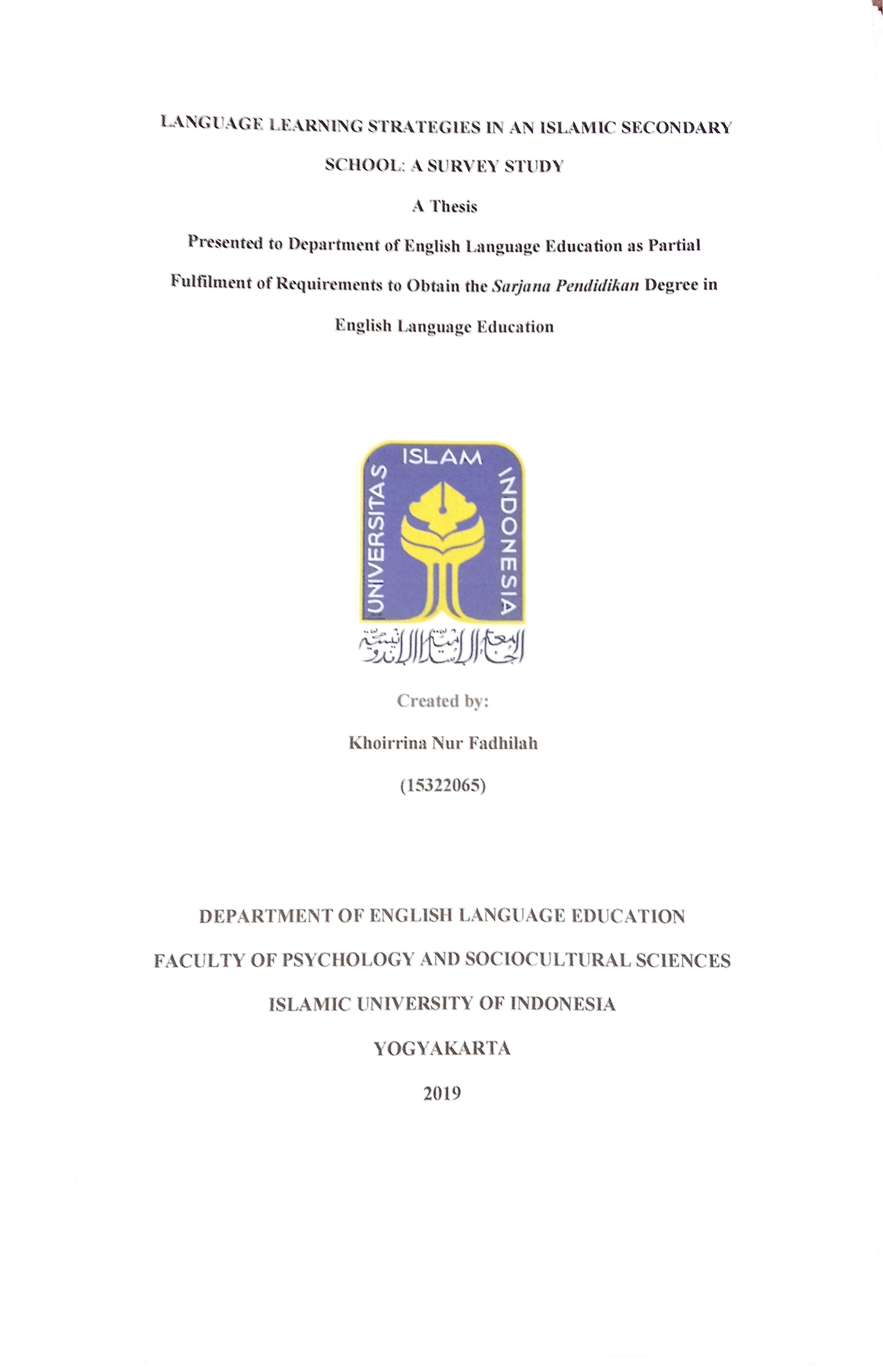
    LANGUAGE LEARNING STRATEGIES IN AN ISLAMIC SECONDARY SCHOOL: A SURVEY STUDY
    Thumbnail
    View/Open
    01 cover.jpg (256.5Kb)
    01 cover.pdf (104.9Kb)
    02 preliminari .pdf (586.7Kb)
    03 daftar isi.pdf (519.7Kb)
    04 abstract.pdf (146.8Kb)
    05.1 bab 1.pdf (292.8Kb)
    05.2 bab 2 .pdf (789.5Kb)
    05.3 bab 3 .pdf (890.6Kb)
    05.4 bab 4.pdf (953.0Kb)
    05.5 bab 5.pdf (165.4Kb)
    06 daftar pustaka.pdf (308.2Kb)
    07.1 lampiran 1.pdf (439.9Kb)
    07.2 lampiran 2.pdf (509.2Kb)
    07.3 lampiran 3.pdf (164.3Kb)
    07.4 lampiran 4.pdf (149.4Kb)
    Date
    2019-10-07
    Author
    Khoirrina Nur Fadhilah, 15322065
    Metadata
    Show full item record
    Abstract
    Islamic secondary school becomes one interesting subject to research language learning strategies because the use language to learn both Islamic values and scientific knowledge learning language such as English, Arabic, and Indonesia at the same time on the curriculum framework can be a challenge for each language development. This survey study aims to identify English as a foreign language (EFL) of language learning strategies used by the students in an Islamic senior high school. The participants of this research are 143 students in grade XII. The instrument used by this research is adapted from Oxford’s questionnaire (1990) named Strategy Inventory of Language Learning Strategies (SILL) version 7.0 for EFL learners that has 50 items and translated into Indonesian Language. The finding of this research shows the highest strategy group is metacognitive strategy from indirect strategies and the lowest strategy group is memory strategies from direct strategies. The data merge from two classes and it will sort from the most frequently used by the student until least frequently used by the students: metacognitive strategies (M= 4.04, SD= 0.81), cognitive strategies (M= 3.68, SD= 0.96), social strategies (M= 3.65, SD= 0.81), compensation strategies (M= 3.63, SD= 0.88), affective strategies (M= 3.53, SD= 0.81), the least is memory strategies (M= 3.48, SD= 0.74).
    URI
    http://hdl.handle.net/123456789/16937
    Collections
    • English Language Education [574]

    DSpace software copyright © 2002-2015  DuraSpace
    Contact Us | Send Feedback
    Theme by 
    @mire NV


    Browse

    All of DSpaceCommunities & CollectionsBy Issue DateAuthorsTitlesSubjectsThis CollectionBy Issue DateAuthorsTitlesSubjects

    My Account

    LoginRegister

    DSpace software copyright © 2002-2015  DuraSpace
    Contact Us | Send Feedback
    Theme by 
    @mire NV