
• Login
    View Item 
    •   DSpace Home
    • Students & Alumnae
    • Undergraduate Thesis
    • Faculty of Industrial Technology
    • Industrial Engineering
    • View Item
    •   DSpace Home
    • Students & Alumnae
    • Undergraduate Thesis
    • Faculty of Industrial Technology
    • Industrial Engineering
    • View Item
    JavaScript is disabled for your browser. Some features of this site may not work without it.

    ACHIEVING SUSTAINABLE DEVELOPMENT GOALS OF CLIMATE ACTION THROUGH ISLAMIC PERSPECTIVE AND THINKING USING THEORY OF CONSTRAINT SYSTEM THINKING
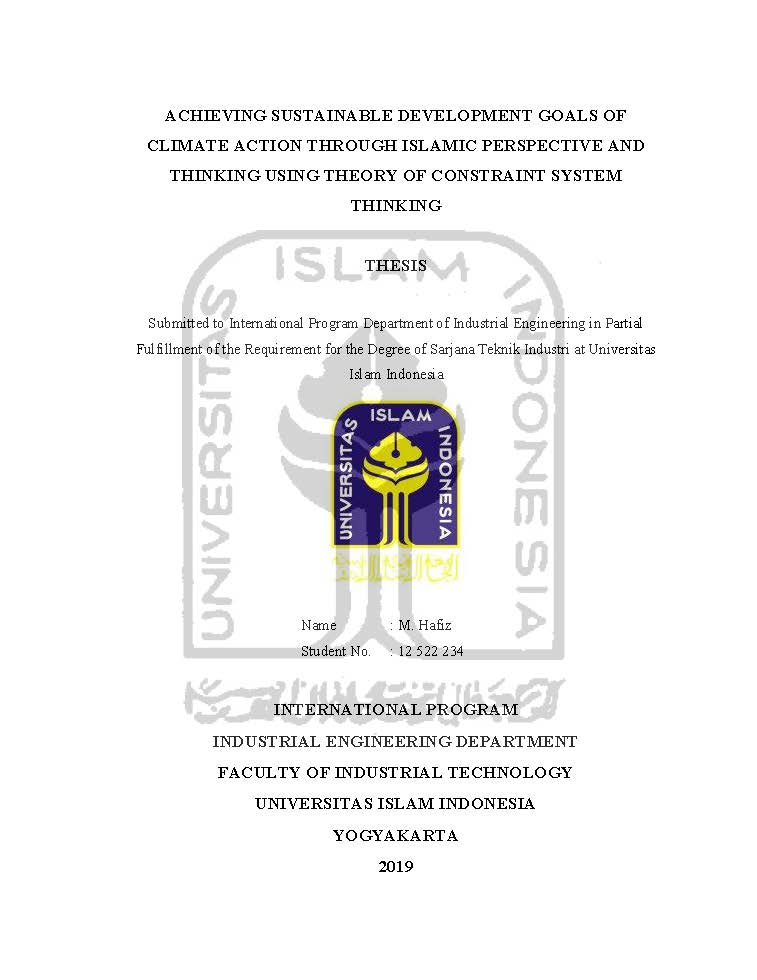
    Thumbnail
    View/Open
    01 cover.jpg (65.38Kb)
    01 cover.pdf (50.48Kb)
    02 preliminari.pdf (138.0Kb)
    03 daftar isi.pdf (131.8Kb)
    04 abstract.pdf (63.32Kb)
    05.1 bab 1.pdf (137.3Kb)
    05.2 bab 2.pdf (375.5Kb)
    05.3 bab 3.pdf (165.7Kb)
    05.4 bab 4.pdf (440.6Kb)
    05.5 bab 5.pdf (178.4Kb)
    05.6 bab 6.pdf (104.4Kb)
    06 daftar pustaka.pdf (225.2Kb)
    Date
    2019-08
    Author
    M. Hafiz, 12522234
    Metadata
    Show full item record
    Abstract
    The Sustainable Development Goals (SDGs) were proposed by United Nations as a shared blueprint for peace and prosperity for people and the planet earth, now and into the future. One of the goal is SDG 13 or also known as Climate Action. However, one of the constraints of achieving this goal is industry sector still the top contributor of emission gases. Through developing the Theory of Constraint, this study aims to finding the root cause of hampering factor from industry in achieving SDG 13 using tools called Current Reality Tree (CRT), offer the solution for conflicted problem using Evaporating Clouds (EC) then inject the Islamic value for future possibility using Future Reality Tree. Based on analysis the root cause that hampering industry from achieving SDG 13 are; 1) Lack implementation of Green Growth and Sustainability Development policies; 2) dependency of industry toward fossil fuel; 3) insufficient policy model to asses the dimension of Material Efficiency strategy; 4) Material impact assessment is still expensive for small medium enterprise; and 5) the indirect impact of consumer demand toward the productions and services.
    URI
    https://dspace.uii.ac.id/handle/123456789/16616
    Collections
    • Industrial Engineering [2864]

    DSpace software copyright © 2002-2015  DuraSpace
    Contact Us | Send Feedback
    Theme by 
    @mire NV


    Browse

    All of DSpaceCommunities & CollectionsBy Issue DateAuthorsTitlesSubjectsThis CollectionBy Issue DateAuthorsTitlesSubjects

    My Account

    LoginRegister

    DSpace software copyright © 2002-2015  DuraSpace
    Contact Us | Send Feedback
    Theme by 
    @mire NV